A wishlist is a customer telling you what to sell them. Cascade listens.
Saved items sit on the same customer record as orders and reviews, and the alerts go out when the price drops or the stock comes back.
The Classic T-Shirt is back.
Something you saved is available again. It sold out once, so this note may age quickly.
View your wishlist
Demand you can read before it converts.
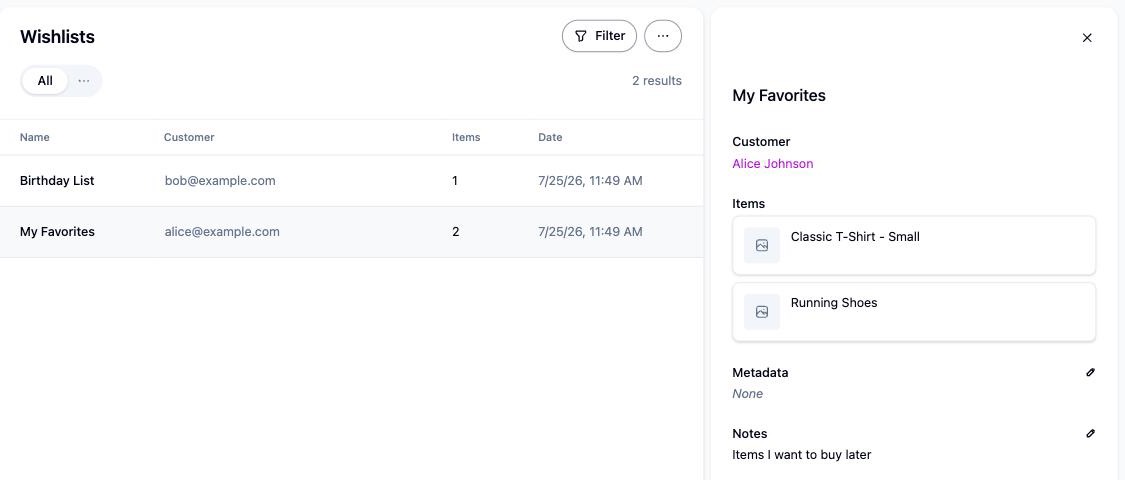
Every list is on the customer's record, beside what they ordered and what they thought of it. You know who is waiting on a product before you reorder it.
Two emails that sell without a campaign.
A wishlist alert is the easiest email in commerce: the customer already said they want the product, and the thing that changed is the thing they were waiting for.
- A price drop email when something a customer saved gets cheaper, sent to the people who told you they wanted it.
- A back-in-stock email when a sold-out variant returns. Only a real restock triggers it, not the first time Cascade learns the stock level.
- Both respect every customer's marketing opt-out, with the unsubscribe handling built in. A wishlist a customer shares themselves is sent regardless, because they asked for it.
Built for gifts, without spoiling them.
Shared lists have a social contract: the owner must not find out what was bought. Cascade enforces it.
- Sharing
- A wishlist can be shared by link, so a birthday list or a registry works without anyone creating an account to view it.
- Purchased tracking
- When someone buys from a shared list, the item is marked so the next viewer does not buy it twice. The list's owner does not see the mark, which keeps the gift a surprise.
- Anonymous marking
- A viewer can mark an item as purchased with a note, without an account, and undo it within a grace period if they change their mind.
- Order matching
- Cascade also matches incoming orders against saved items on its own, so a purchase marks the item even when nobody remembered to.
The rest of Cascade.
Every feature runs on the same customer record and the same REST API, so each one you turn on makes the others worth more.